

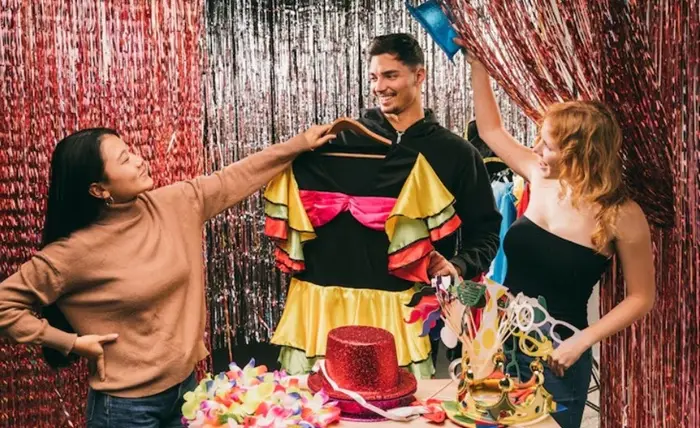
The invitation arrives with enthusiasm you cannot match. A theme has been chosen, a date has been set, and attendance is expected. Perhaps it is a decade party requiring disco attire or eighties excess. Perhaps it is a costume theme demanding you transform into something you have no interest in becoming. Your friends seem excited. You feel something closer to dread. The party itself might be fine, but the requirement to dress up triggers resistance that feels disproportionate to the ask. Yet here you are, committed to attending and facing the question of what to wear when you would rather wear nothing special at all.
Understanding Your Resistance
Before solving the practical problem of what to wear, it helps to understand why theme parties provoke such reluctance in some people. The resistance usually stems from one of several sources. Some people dislike the performative expectation, the demand that they become entertainment rather than simply attending an event. Others feel anxiety about getting the costume wrong, either under-dressing relative to enthusiastic guests or over-committing and feeling foolish. Still others resent the time, expense, and mental energy required to assemble an outfit they will wear once and never again.
These feelings are valid. Theme parties ask something extra from guests, and not everyone finds that ask enjoyable. Recognising that your reluctance is legitimate rather than some personal failing makes the whole process easier. You are not broken for disliking costume requirements. You simply have different preferences than the people who planned the event. The goal is finding an approach that respects your preferences while still participating in good faith.
The Minimum Viable Costume
The minimum viable costume acknowledges the theme without demanding full transformation. It signals participation while requiring minimal effort, expense, and discomfort. The key is identifying which single element most strongly communicates the theme and focusing your energy there. Everything else can remain close to your normal attire.
For decade themes, this often means one era-appropriate accessory paired with clothes you already own. A seventies party might require only a headband and some beads over a plain outfit. An eighties theme can be satisfied with bright accessories and deliberately mismatched colours. Pirate costumes can be reduced to a bandana and an eye patch worn with dark jeans and a white shirt. The effect is sufficient. You are clearly participating without having constructed an elaborate disguise. Most hosts appreciate any effort, and most guests are too focused on their own costumes to scrutinise yours.
The Elevated Normal Approach
Another strategy involves dressing in your normal style but elevating one aspect to nod toward the theme. This works particularly well for themes with flexible interpretation. A glamour theme might mean wearing your nicest existing outfit with slightly more dramatic makeup. A festival theme could involve your regular clothes with added temporary tattoos or glitter. The result looks intentional without feeling like a costume.
This approach suits people who feel uncomfortable in true costumes but still want to show respect for the occasion. You are not ignoring the theme. You are interpreting it in a way that aligns with your personal style. Some themes accommodate this better than others. A masquerade ball practically invites this approach, since a beautiful mask transforms any formal outfit into themed attire. Specific character requirements are harder to adapt, but most social themes leave room for interpretation.
The Attitude Adjustment
Sometimes the most effective strategy involves internal rather than external change. Theme parties become more tolerable when you adjust what you expect from them. Rather than viewing the costume requirement as an imposition, consider it the price of admission to an event your friends care about. You do not have to love dressing up. You just have to be willing to do it occasionally for people you value.
This reframing helps with the experience itself, not just the preparation. Committing to participation, even reluctantly, often produces more enjoyment than half-hearted attendance. The person who arrives in a genuine attempt at costume, however simple, has a different night than the person who shows up in regular clothes broadcasting their refusal to play along. Social events reward buy-in. Offering that buy-in, even when the theme is not your preference, tends to produce a better time for everyone, including you.
Finding Your Limit
Not every theme party requires attendance. If you genuinely cannot face the costume requirement, declining is an option. True friends will understand that this type of event is not for you. You can celebrate with them in other ways that suit your preferences better. The obligation to attend everything you are invited to is self-imposed and can be released.
However, if you choose to attend, commit to the premise at whatever level you can manage. The minimum viable costume, the elevated normal approach, the conceptual interpretation, the hired outfit—any of these represent good faith participation. They get you through the door with your dignity intact and your friendships honoured. Theme parties may never become your favourite events, but they do not have to be ordeals. With the right approach, they can be perfectly fine evenings spent with people you enjoy, wearing something slightly ridiculous that you will forget about by the following week.