

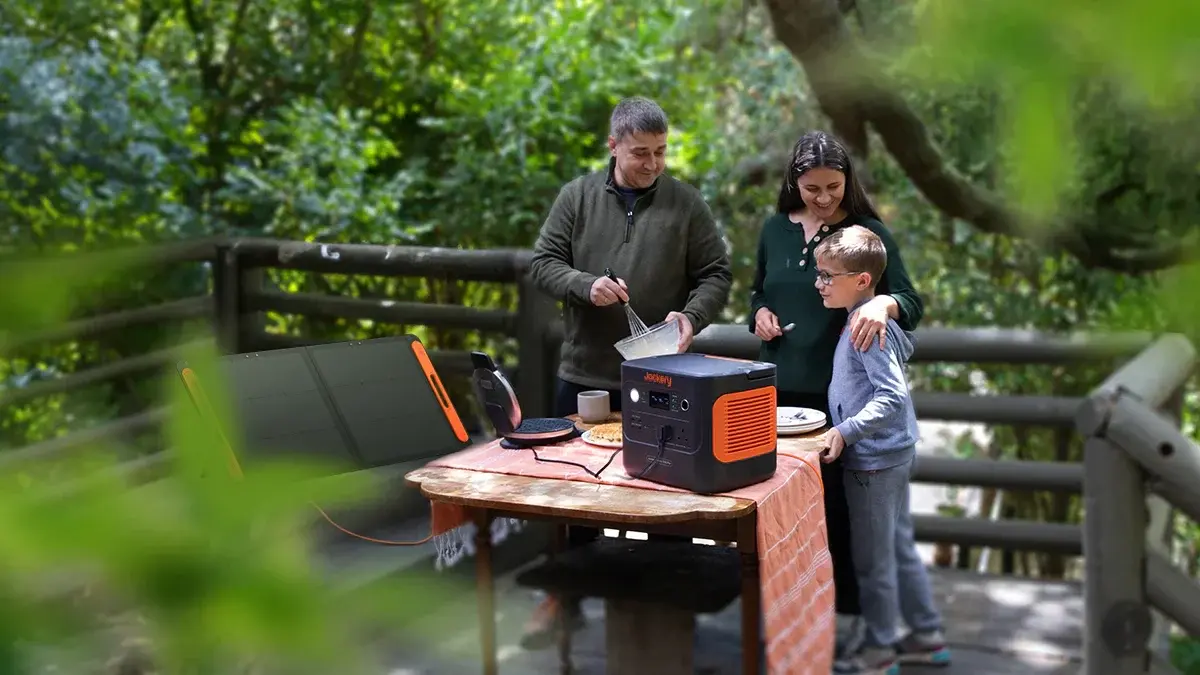
Camping in the UK has leaned towards comfort and convenience. People head for managed sites, bring lighting, heating, a coffee machine and sometimes a small fridge. That puts power on the kit list. Fewer campers want a fuel generator with the noise and fumes, so a portable power station is the tidy alternative — quiet, simple, and easy to top up with solar.
Jackery’s Explorer 1000 v2 and Explorer 1000 Plus often appear on the same shortlist. They sit in the 1 kWh class but take different design paths. The detail below explains where they differ and why that difference matters, so you can pick a portable power station for camping that matches the way you actually camp.
Comparing the Core Specs
- Battery and Durability
Both models use LFP (LiFePO₄) cells for stability and long service life.
| Item | Explorer 1000 v2 | Explorer 1000 Plus |
| Battery type | LFP (LiFePO₄) | LFP (LiFePO₄) |
| Capacity | 1070Wh | 1264Wh |
| Cycle life | ≈ 4000 cycles to 70% | ≈ 4000 cycles to 70% |
| Weight | ≈23.8 lbs (10.8 kg) | ≈32 lbs (14.5 kg) |
What the Numbers Mean: the chemistry and cycle life are the same, so longevity isn’t the deciding factor. The practical trade-off is weight versus watt-hours. ~10.8 kg is easier to carry from car park to pitch. 1264 Wh gives roughly 18% more stored energy than 1070 Wh, which extends run time when you’re off hook-up or recharging cameras, drones and lights overnight.
- Power Output and Real-World Appliances
Output defines what you can switch on at once and how comfortably the inverter handles heat-based loads.
| Device | Explorer 1000 v2 | Explorer 1000 Plus |
| Coffee machine | 550W, ~1.5 hrs | 1120W, ~1 hr |
| Microwave | 1160W, ~0.8 hr | 1160W, ~56 min |
| Projector | 100W, ~8 hrs | 100W, ~10 hrs |
| Drone | 90W, ~25 charges | 90W, ~30 charges |
| Electric kettle | 600W, ~6 boils | 1600W, ~0.7 hr |
1000 v2 outputs 1500 W, which is comfortable for lights, coolers, laptops, projectors and modest kitchen kit. 1000 Plus raises this to 2000 W with 4000 W peak, giving extra headroom for heating elements and appliances with higher inrush. Brits are known for their love of tea, and household kettles here tend to be fairly powerful — usually rated between 2.5 kW and 3 kW. The Plus handles 1600 W models without fuss, while the v2 favours gentler boils or using the hob. Whichever you bring, run one heavy item at a time and check the rating label — it keeps any power station within limits.
- Charging and Top-Ups
Both support mains, car and solar charging. Mains speeds are close; solar input is where they diverge.
| Charging | Explorer 1000 v2 | Explorer 1000 Plus |
| Mains charging | ~2 hrs (Emergency mode ≤ 1 hr) | ~Ultra Fast Wall Charging 100 Mins |
| Solar charging | 100 W × 2 ≈ 7.5 hrs | 200 W × 4 ≈ 2 hrs |
| Car charging | ~12 hrs | ~14.5 hrs |
A full mains charge on Friday usually covers a short weekend. If you rely on solar for longer stints, the Plus’s higher input (up to four 200 W panels) restores capacity faster in decent light. UK reality: spring and summer do fine; winter takes longer. Car sockets replenish slowly by design, so treat them as overnight top-ups. If you’re packing panels, consider boot space, avoid shade, and angle towards the sun where possible.
- Smart Features and Safety
The safety and control approach is consistent. UPS (≤ 20 ms) provides near-instant switchover during brief power cuts at home, keeping a desktop, router or aquarium running. The Jackery app shows state of charge, input/output power and time remaining, and lets you adjust charging behaviour.
Noise is kept low: Explorer 1000 v2 operates around 22 dB; Explorer 1000 Plus adds a ≤ 30 dB silent-charging mode. One structural difference: the Plus can be expanded to ~5 kWh with extra battery packs, which increases off-grid duration and makes a single unit more viable for light home backup as well as campsite use.
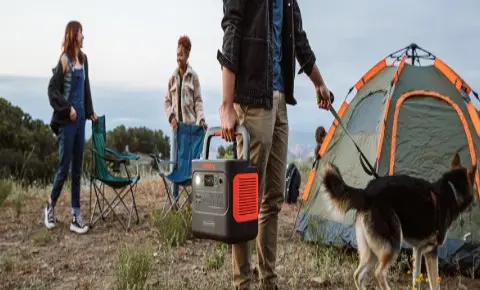
Which one suits you?
Explorer 1000 v2 — for weekend camping
If you value lower carry weight, quick mains top-ups and a clean setup for typical weekend loads. The 1500 W inverter and 1070 Wh capacity line up well with lighting, refrigeration, AV and smaller kitchen appliances.
Explorer 1000 Plus — for luxury glamping and multi-use
If your kit includes higher-draw items or you stay off hook-up for longer. The 2000 W output, higher solar intake and optional expansion to ~5 kWh reduce compromises and suit luxury glamping or a unit that doubles for light home backup.
FAQs
- Are these units weatherproof?
No. Keep the portable power station dry under cover (awning/tent porch) and off wet ground. Use outdoor-rated, RCD-protected leads and keep vents clear. Folding solar panels are weather-resistant but keep the connectors out of standing water.
- How should I look after it in cold UK weather or during storage?
Avoid charging below 0°C — let the unit warm up first. In cold weather, keep it dry, off the ground, and expect shorter runtimes. For storage, hold about 50–60% charge, top up every few months, and store somewhere cool and dry, away from direct sunlight.
Conclusion
Both are quiet, stable and built on long-life LFP cells. The decision rests on three practical points: how far you carry it, what you switch on, and how you recharge. Match those to your trips and you’ll end up with the portable power station that does exactly what you need — no more, no less.
Ready to power your next trip? Explore both models on Jackery’s UK site and find the setup that fits your style — whether it’s a quick weekend pitch or a luxury glamping base that runs like home.
View Jackery Explorer 1000 v2 and Explorer 1000 Plus Portable Power Station here.